
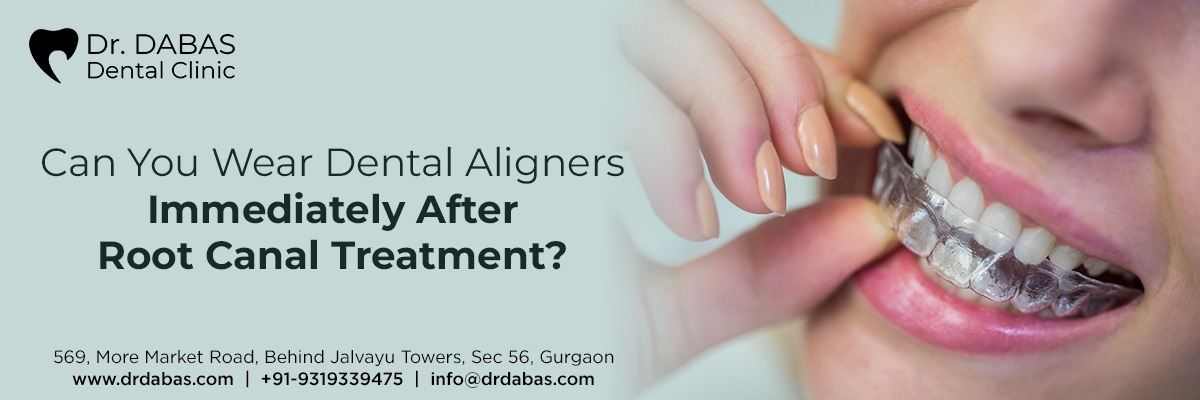
If you have just completed a root canal treatment & are scheduled to start or continue dental aligners – it is completely normal to wonder whether you can wear the aligners immediately or if you should wait for a few days. Many people assume that once the root canal is finished, the tooth is ready for orthodontic treatment. However, that is not always true. Dentists first check – whether the tooth is healing well, whether there is any pain while biting, whether swelling or infection is still present and whether the filling is strong enough for tooth movement. To understand the right timing – it is important to first understand what happens during a root canal and how dental aligners move teeth.
People generally think a root canal means the entire tooth is removed or becomes completely “dead.” But that is not what happens.
A root canal is done when the soft tissue inside the tooth (the pulp) becomes infected or inflamed. This can happen because of – deep decay, a fracture, trauma, repeated dental work or a long-standing infection.
After a root canal, the tooth is still attached to the jaw by the periodontal ligament. This supporting tissue continues to stay active & is responsible for the controlled movement of teeth during braces and aligner treatment. Therefore, a tooth that has undergone root canal treatment can usually still be moved orthodontically when the surrounding tissues are healthy and the tooth is healing properly
Dental aligners work in a gradual and controlled way. They are designed to apply gentle pressure on specific teeth rather than moving them suddenly. This pressure acts on the periodontal ligament around the tooth – while the surrounding bone slowly adjusts to the new position. As a result, teeth usually move in very small amounts over several days or weeks.
For aligner treatment to remain comfortable and predictable, both the tooth and the supporting tissues around it need to be in a healthy condition. Dentists become more cautious if there is:-
This is why someone considering a dental aligner in gurgaon may be asked to complete certain dental treatments before orthodontic movement begins.
Here is the practical answer dentists often use:-
Situation | Usually safe? |
root canal completed, no pain or swelling | often yes |
only a temporary filling is present | sometimes / with caution |
pain while biting | usually wait |
swelling or abscess | no |
tooth needs a crown for strength | often delay movement |
cracked tooth or retreatment needed | no |
Many uncomplicated cases can resume aligners within a few days. However, same-day wear is not automatically safe just because the procedure is finished.
If there is swelling, pus, fever or throbbing pain – the tooth should usually not be moved yet. Orthodontic pressure on an actively infected tooth can increase discomfort
Mild soreness for 24-72 hours after a root canal is common. Sharp pain when chewing is different and may suggest a high filling, persistent inflammation or another problem
A temporary filling is useful but it is not as durable as a permanent restoration. Large cavities can leave the tooth weaker during the healing phase
If a large portion of the tooth is missing, dentists often prefer to strengthen it before significant orthodontic movement
When infection has affected the bone around the root, healing may need to be monitored before aligner forces are applied These factors are routinely considered during root canal treatment in Gurgaon when future orthodontic treatment is planned
This is particularly important when the patient is a child or teenager. Their jaws are still developing and the success of aligner treatment depends a lot on how comfortably and consistently they can wear the aligners.
After a root canal, some children may find it difficult to:-
Parents sometimes try to continue aligner wear even when the child is experiencing significant discomfort. However, if there is swelling, severe pain or difficulty eating, a short pause advised by the dentist is often safer than repeatedly removing and reinserting the aligners. For families considering dental aligners in Gurgaon, understanding the child’s comfort & cooperation is often more important than focusing only on the exact number of days to wait.
There is no universal waiting period but these ranges are commonly used in clinical practice:-
These timelines are only general clinical ranges and should not be treated as fixed rules. The healing response can vary from one person to another and even two teeth in the same mouth may not recover at exactly the same speed
These signs suggest that the tooth needs evaluation before orthodontic movement continues
Before restarting aligners, ask:-
If the answer is yes to all six, aligners are often safe to resume. If one or more answers are no, the tooth usually needs further evaluation
In most cases, a tooth that has undergone root canal treatment can still be moved safely with aligners. However, the right timing depends on proper healing, absence of infection, comfort while biting & the strength of the filling or crown.
At Dr. Dabas Dental Clinic, we carefully evaluate the treated tooth, surrounding bone & overall orthodontic plan before advising when aligners should begin or continue. This coordinated planning helps avoid unnecessary pain, treatment delays and future complications.
If you are looking for trusted guidance for root canal treatment, aligners or complete dental care – our team works with the precision and experience expected from the best orthodontist in gurgaon sec 56 and a comprehensive dental clinic focused on long-term oral health.
Error: Contact form not found.