
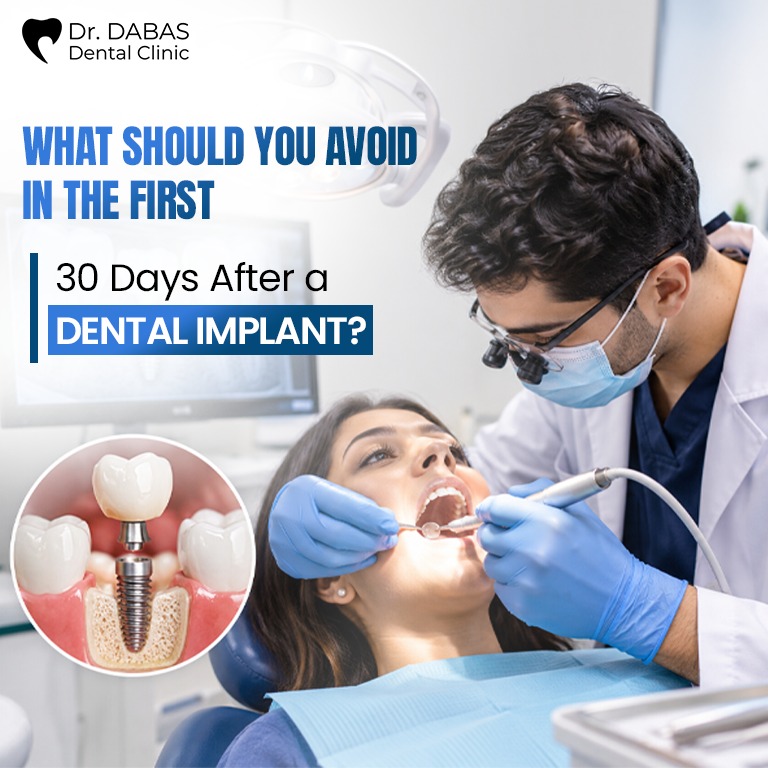
What Should You Avoid in the First 30 Days After a Dental Implant?

A dental implant is designed to replace a missing tooth but its long-term success depends greatly on the first 30 days after the procedure. During this period, the implant is still integrating with the surrounding bone & excessive pressure, smoking, poor oral hygiene or certain daily habits can interfere with healing. This guide is for patients recovering after a dental implant in Gurgaon as well as family members supporting them during the healing phase. It explains the most important restrictions, the expected recovery timeline and the warning signs that should not be ignored. Understanding these first 30 days can help protect the implant, reduce complications and support a smoother recovery with greater confidence:-
What is actually healing during the first month? 
To understand the restrictions, it helps to know what is happening under the gums:-
  • First 24 hours – Blood clot protection
A small blood clot forms around the implant. This clot acts like a natural protective dressing and provides the foundation for healing
  • Days 2-7 – Swelling and soft tissue closure
Mild swelling, slight bleeding &tenderness are common. The gums begin closing around the implant
  • Week 2 – Gum sealing and reduced discomfort
The soft tissue becomes more stable. Most patients feel significantly better by this stage
  • Weeks 3-4 – Early bone integration begins
This phase is often misunderstood by everyone. During this the dental implant may feel comfortable but the bone attachment is still developing and can be disturbed by excessive force Bone healing is not the same for everyone. Smokers, diabetics, people with lower bone density and patients who had bone grafting may require a more cautious recovery.
The 5 mistakes that can disturb a dental implant in the first 30 days 
These are the habits that experienced implant dentists watch for most closely during the first month:-
1. Chewing hard or crunchy foods too early
This is probably the most common mistake.
What to avoid
  • Nuts
  • Toast
  • Chips
  • Hard roti edges
  • Raw carrots
  • Popcorn
  • Ice
Early biting pressure can create tiny movements around the implant. Excessive micromovement during early healing may interfere with stable bone integration
A safer food timeline 
  • First 7 days –  soft foods only
  • Week 2 – chew soft food on the opposite side
  • Weeks 3-4 – gradually return to firmer foods only if your dentist has advised it
Foods that are usually safer 
  • Khichdi
  • Dal
  • Curd
  • Soft paneer
  • Mashed vegetables
  • Well-cooked rice
If you need to bite with effort, the food is probably too hard for the first few weeks
2. Smoking, vaping and alcohol during early healing
Smoking is not at all advisable during this phase. Even limited smoking can affect healing:-
Why smoking is risky
  • reduces blood supply to the gums
  • slows tissue repair
  • increases infection risk
  • increases the chance of implant complications
Why alcohol is also a concern
  • may increase bleeding during the first 24-48 hours
  • can irritate healing tissues
  • can interact with prescribed medicines
How long to avoid them 
  • Smoking/vaping – avoid for at least 2-4 weeks
  • Alcohol – avoid for at least 72 hours and longer if swelling persists
Patients who stop smoking even temporarily during the first month often heal noticeably better than those who restart within the first week
3. Disturbing the surgical area without realising it
Common habits that cause irritation:- 
  • touching the area with fingers
  • pressing it with the tongue
  • pulling the cheek repeatedly to check the implant
  • spitting forcefully
  • rinsing aggressively
  • using a straw in the first 24 hours
Negative pressure and repeated movement can dislodge the clot and irritate the healing tissues
The safest approach during the first 24 hours:- 
  • First 24 hours – no spitting, no straw, no vigorous rinsing
  • After 24 hours – gentle rinsing only if advised by your dentist
Repeatedly checking the implant with the tongue is one of the most frequent causes of unnecessary irritation during the first week
4. Returning to the gym or heavy activity too soon
Feeling energetic does not mean the implant is ready for physical stress:-
Activities to avoid 
  • weight lifting
  • running
  • HIIT workouts
  • contact sports
  • swimming during the first few days if advised
Heavy activity increases blood pressure & may worsen swelling or bleeding. Contact sports also carry a risk of accidental facial trauma
A realistic return-to-activity timeline 
  • Desk work – usually after 24-48 hours
  • Light walking – after 24 hours
  • Gym and weights – wait at least 5-7 days
  • Contact sports – often 2-4 weeks or as advised
For teenagers and young adults, this restriction is especially important because they tend to resume sports earlier than recommended
5. Ignoring warning signs that are not normal
Not every symptom is dangerous, but some should never be ignored:-
Usually normal symptoms 
  • mild swelling for 2-3 days
  • slight bleeding or pink saliva
  • bruising
  • a dull ache controlled by medicines
Symptoms that need dental attention 
  • swelling that increases after day 3
  • throbbing pain
  • fever above 38°C
  • pus or foul discharge
  • the implant feeling loose
  • increasing difficulty opening the mouth
Symptoms that improve a little each day are usually part of healing – symptoms that become more intense after the third day deserve professional review Recovery, daily care & long-term implant success
The first week after a dental implant usually gets the most attention – but the next three weeks are just as important. This is the phase where patients often start feeling normal again and unknowingly return to habits that can disturb healing.
Your 30-day recovery timeline 
Time period Main thing to avoid
Day 1 spitting, straws, smoking, hot foods
Days 2-3 hard chewing and heavy exercise
Days 4-7 chewing on the implant side and alcohol
Week 2 crunchy foods and aggressive brushing
Weeks 3-4 excessive biting force & neglecting oral hygiene
For most patients, soft Indian foods remain the safest choice during the early stages. Khichdi, dal, curd, soft paneer, mashed vegetables & well-cooked rice are usually easier on the surgical area than – toast, chips, nuts or hard roti edges
Oral hygiene during the healing phase 
Many people either avoid cleaning the area completely or clean it too aggressively. Both can cause problems:-
Brushing around the implant 
  • continue brushing the other teeth normally from the first day
  • around the implant, use a soft-bristled toothbrush
  • avoid scrubbing directly over the stitches for the first few days
Using mouthwash correctly 
If chlorhexidine mouthwash has been prescribed, use it exactly as directed. More is not better. Prolonged or unnecessary use can sometimes cause staining or alter taste temporarily
Flossing and water flossers 
  • Traditional flossing near the implant is usually introduced only when the dentist confirms that the gums have sealed adequately
  • A water flosser is generally not recommended during the very first days after surgery especially if used on a high-pressure setting
Sleeping and daily activities after a dental implant 
The first two nights are often when swelling becomes more noticeable:-
Best sleeping position
  • Sleep with the head elevated on 1-2 pillows
  • Avoid sleeping on the side of the implant if it increases pressure or discomfort
Office work, driving and household activities 
  • Talking is generally safe
  • Office work is usually possible within 24-48 hours
  • Driving is acceptable once the effect of sedation & strong pain medicines has worn off
  • Light household work is usually fine but avoid bending repeatedly & lifting heavy objects during the first few days
Special considerations for teenagers and young adults 
Young patients often heal quickly – but they also tend to return to normal habits too early. Pay attention to these situations:-
  • Resuming gym workouts within a few days
  • Contact sports without protection
  • Late-night snacking on crunchy foods
  • Inconsistent brushing
  • Peer pressure around smoking or vaping
  • Anxiety about appearance and repeatedly checking the implant
If the patient is also undergoing orthodontic treatment or considering a dental aligner in Gurgaon – the implant & aligner plan must be coordinated carefully. Implants do not move like natural teeth, so treatment sequencing matters
Habits effective in improving long-term implant success 
  1. Follow the food timeline strictly, especially during the first 2 weeks
  2. Keep the mouth clean. Gentle but regular cleaning reduces plaque buildup
  3. Take prescribed medicines on time. Do not stop antibiotics or pain medicines early without  advice
  4. Avoid smoking completely if possible. Even temporary abstinence improves blood supply & healing
  5. Attend follow-up visits. Small problems are much easier to correct early
These are the habits experienced implant dentists repeatedly see in patients whose implants remain healthy for many years.
Why do patients choose Dr. Dabas for long-term dental implant care in Gurgaon 
Successful dental implant treatment depends not only on the surgery – but also on the care taken during the first 30 days. Careful eating, gentle cleaning, avoiding smoking and attending follow-up visits can greatly improve healing & long-term stability. At Dr. Dabas Dental Clinic – we believe patients deserve clear guidance at every stage of treatment. Our team focuses on detailed treatment planning, modern implant techniques, transparent communication and long-term oral health. Families trust us because we treat children, adults and senior patients with the same level of attention and care. If you are looking for the best dental clinic in Gurgaon, book a consultation with us & get a treatment plan guided by our specialists using advanced technology and personalised long-term care designed for lasting results. 

Enquire Now